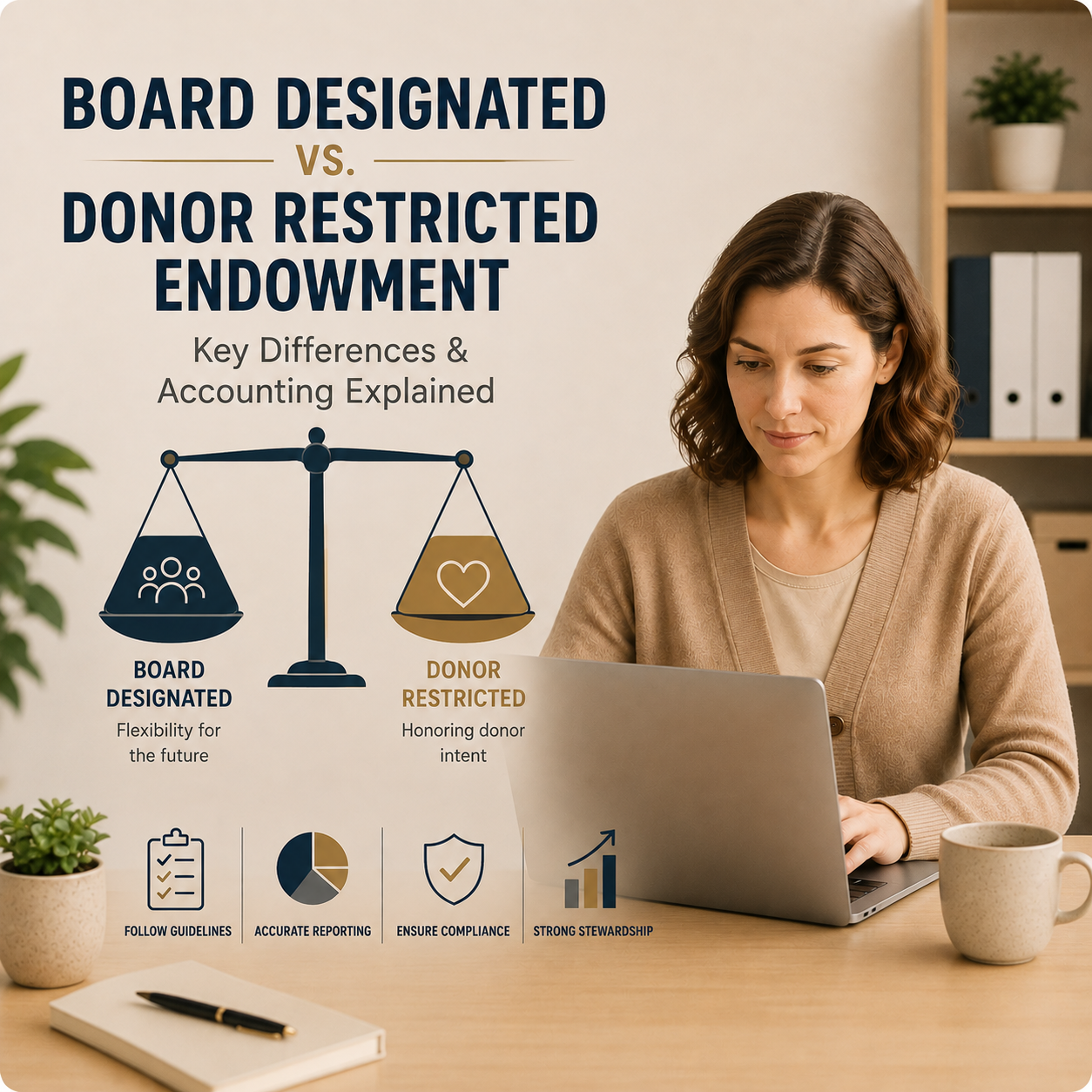
Understanding Board Designated and Donor Restricted Endowments
Definitions of Each Type
- Donor-restricted endowment: A gift the donor imposes an external restriction on, typically requiring the principal be retained in perpetuity (often called a true or permanent endowment). The donor’s intent controls what can be spent and for how long. Accounting and legal obligations flow from that donor-imposed restriction.
- Board-designated endowment: Also called a quasi endowment when set by the board, this is money the board has internally set aside to function like an endowment. Legally and for accounting purposes, these funds remain part of unrestricted net assets because the board — not an outside donor — can change or release the designation.
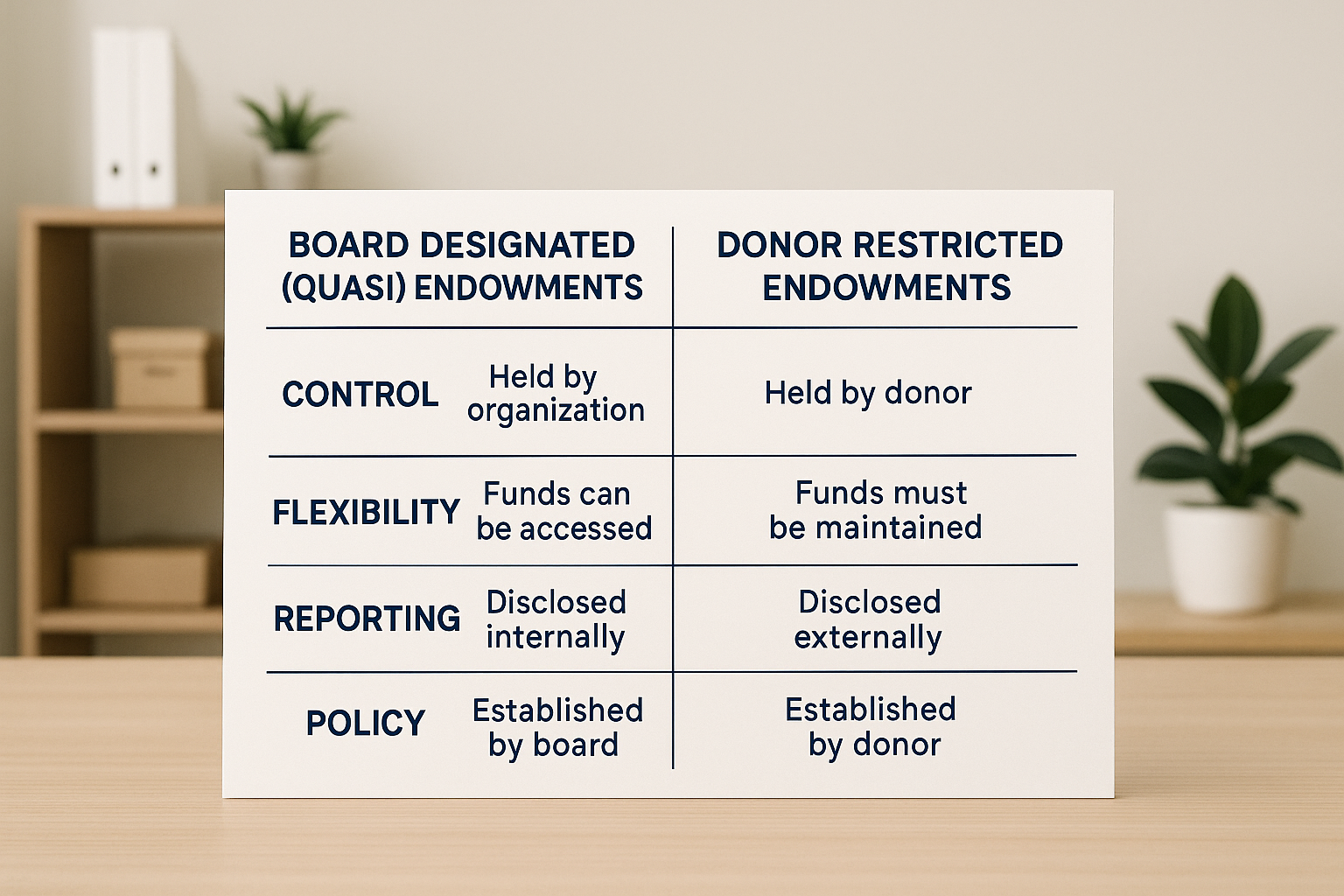
Key differences at a glance:
- Control: Donor versus board.
- Flexibility: Donor restrictions are legally binding; board designations are reversible.
- Reporting: Donor-restricted goes in net assets with donor restrictions; board-designated sits in net assets without donor restrictions.
- Policy: Donor agreements and sometimes state law (e.g., UPMIFA) govern donor-restricted funds; board policy governs designated funds.
Why this matters: misclassifying a donor-restricted endowment as board-designated (or vice versa) can lead to improper financial statements, upset donors, and even legal risk. So yeah — a small label with big consequences.
Practical Examples and Use Cases
Example 1 — Donor-restricted endowment: A foundation gives $500,000 “to create an endowment to support scholarships in perpetuity, with only investment income available for scholarships.” That $500,000 principal is donor-restricted; your organization may record investment returns as temporarily restricted (if the donor limits use), or recognize release from restriction as spending rules allow. You cannot spend the principal unless the donor says so or a court permits modification.
Example 2 — Board-designated endowment (quasi): Your board votes to designate $300,000 from accumulated reserves as an endowment for long-term program support. However, legally it’s still unrestricted: the board can later vote to use part of the principal in a financial emergency. Meanwhile, for accounting purposes, you present it as “board-designated” within net assets without donor restrictions.
Use cases:
- Board-designated funds are useful when you want permanence without donor strings — for planned future stability, strategic investment pools, or to communicate long-term commitment to donors.
- Nonprofits often use donor-restricted funds to honor donor intent, attract funders seeking permanence, and build credibility for scholarship, capital, or programmatic continuity.
Practical tip: When soliciting endowed gifts, make donor intent explicit in written agreements. If you want flexibility, draft the gift agreement to allow specific circumstances or include language consistent with your spending policy.

Endowment Accounting in Nonprofits
Accounting Standards and Guidelines
Two frameworks guide endowment accounting in U.S. nonprofits: generally accepted accounting principles (GAAP), primarily FASB ASC 958 for not-for-profit entities, and state laws such as the Uniform Prudent Management of Institutional Funds Act (UPMIFA), which many states have adopted.
What ASC 958 requires in broad terms:
- Classify net assets by donor restrictions (with or without).
- Recognize contributions based on donor-imposed restrictions.
- Disclose composition of endowment funds and governing policies (spending, investment).
- Report investment return and changes in endowment principal in the statement of activities and disclosures.
UPMIFA affects practical spending decisions and legal prudence. Important features:
- Provides a modern prudence standard for spending from endowments (including guidance for underwater endowments).
- Many organizations use UPMIFA as the legal framework for deciding whether to spend from underwater funds and how to interpret donor intent when circumstances change.
Accounting distinctions to keep straight:
- Donor-restricted endowment principal: reported as net assets with donor restrictions — often permanently restricted.
- Investment income or appreciation: treatment depends on donor language; some donors restrict income usage, others do not.
- Board-designated funds: reported within net assets without donor restrictions, though organizations should disclose them as board-designated for transparency.
Avoid the trap: A board cannot convert a donor-restricted endowment to board-designated status unilaterally. Consequently, doing so would violate donor intent and likely be improper accounting.
Financial Statement Presentation and Disclosure Requirements
How this looks on the statement of financial position (balance sheet):
- Net assets without donor restrictions
- Undesignated (operating reserves, general fund)
- Board-designated endowment funds (quasi endowment)
- Net assets with donor restrictions
- Temporarily restricted (if applicable)
- Permanently restricted (donor-restricted endowment principal)
Disclosure best practices (these go in your notes to the financial statements):
- A clear table showing beginning and ending balances of donor-restricted and board-designated endowments (principal, accumulated appreciation, spending, additions).
- Your endowment spending policy (spending rate, calculation method — e.g., 4% of a rolling average).
- Investment policies and objectives.
- Policies for dealing with underwater endowments (if any).
- Any board actions affecting endowment funds during the year.
Example disclosure summary (short form):
- Beginning donor-restricted endowment principal: $500,000
- Additions: $50,000
- Investment return: $40,000
- Amounts appropriated for spending: ($20,000)
- Ending donor-restricted principal: $570,000
Wrap-up: Accurate presentation and full disclosures build donor trust and keep auditors happy. Don’t treat disclosures as an afterthought.
Quasi Endowments Explained
Definition and Characteristics
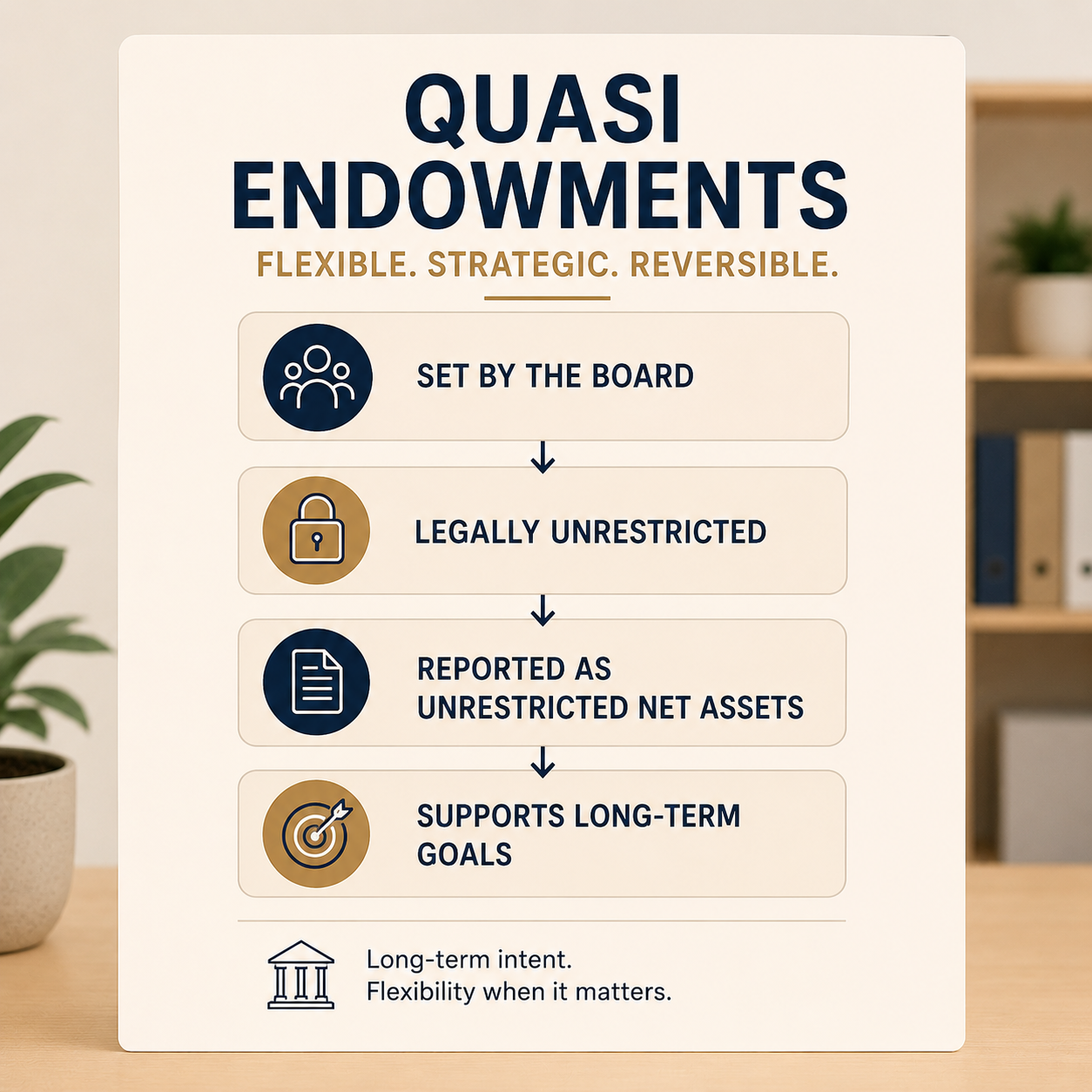
Quasi endowments are funds the board designates to function like an endowment but that legally remain unrestricted. Characteristics:
- Set by internal board resolution, not donor gift instrument.
- Can be spent if the board later votes to do so.
- Useful for long-term stability, seed capital, or to demonstrate commitment to future stewardship.
Comparison with donor-restricted endowments:
- Flexibility: quasi is flexible; donor-restricted is not.
- Permanence: quasi can be reversed; donor-restricted is intended to be permanent.
- Reporting: quasi appears as part of unrestricted net assets but flagged as board-designated.
Small governance caution: Because quasi endowments are unrestricted, organizations sometimes use them to mask poor liquidity planning — don’t let “designated” become a false promise to stakeholders.
Accounting and Management of Quasi Endowments
Accounting:
- Reported in net assets without donor restrictions.
- Disclose separately in notes (composition, board action establishing the designation, and spending policy).
- Investment gains/losses flow through unrestricted activity unless the board imposes another internal rule.
Management best practices:
- Adopt a written board resolution when creating a quasi endowment — include purpose, spending rule, and conditions for redesignation.
- Tie the quasi endowment to an investment policy and an approved spending policy (e.g., 4–5% of a trailing 12-36 month average).
- Review the designation annually in board finance or investment committee meetings.
Example policy clause: “The board-designated endowment is intended to provide long-term support for program X. The board will review the spending rate annually and may redesignate the funds by a majority vote.”
Wrap-up: Quasi endowments combine flexibility with a need for disciplined governance. Good policy prevents future acrimony.
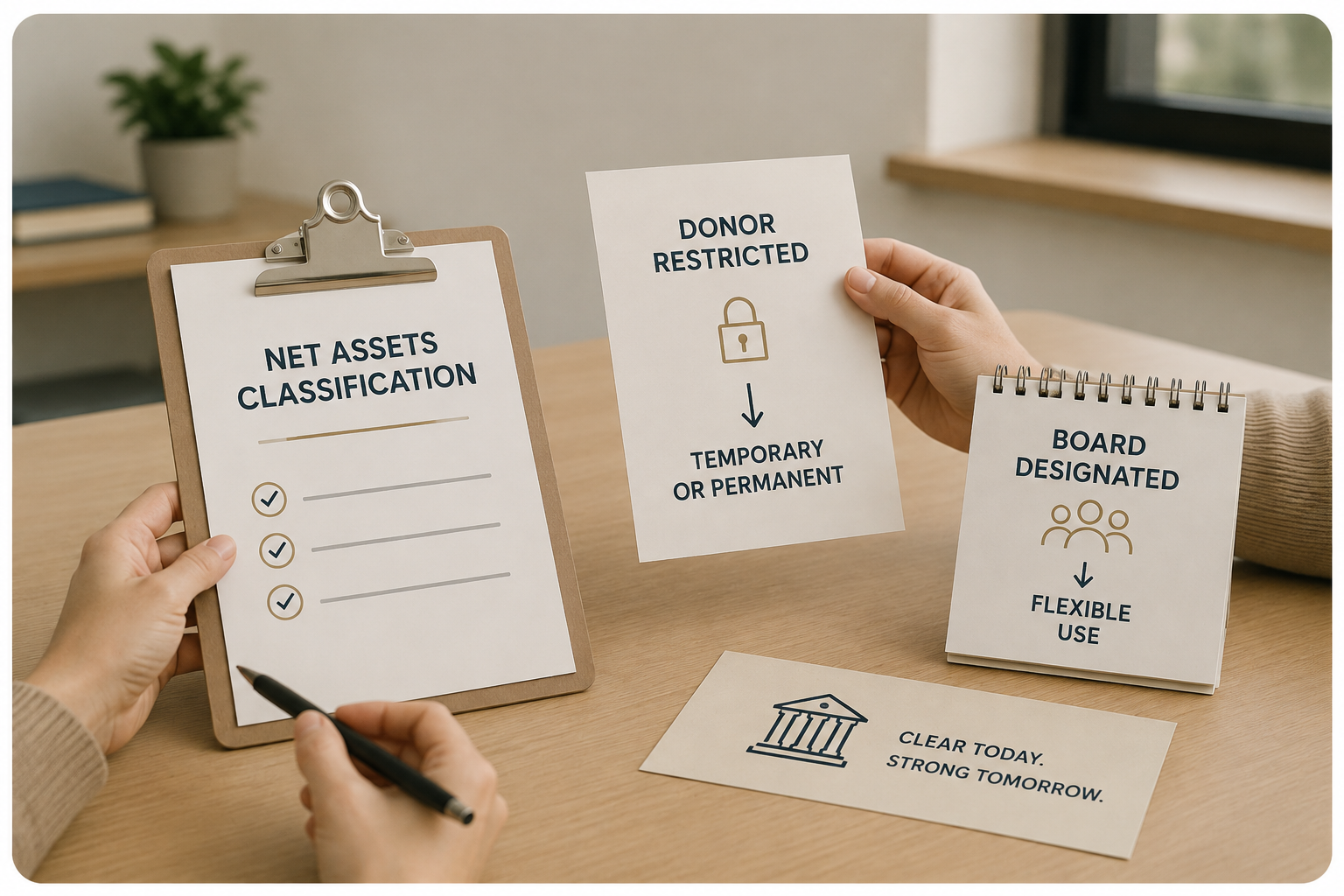
Classification of Endowment Net Assets
Net Assets with Donor Restrictions
Donor-restricted net assets are those subject to donor-imposed limitations — either temporary (spent when conditions are met) or permanent (principal preserved in perpetuity). For endowments, donor restrictions most commonly create permanently restricted net assets for principal and temporarily restricted net assets for income if the donor limits its use.
Common scenarios:
- Donor says “use only income for scholarships” → principal becomes permanently restricted; income may become temporarily restricted depending on the wording.
- Donor says “use for library renovations” with no time limit → possibly temporarily restricted until expended.
Practical accounting note: If a donor restricts both purpose and time, report as temporarily restricted and release as conditions are met.
Net Assets without Donor Restrictions
Net assets without donor restrictions include funds the board has designated for future use (quasi endowment) and operating reserves. Board designation is an internal action; it does not create a legal restriction.
Why classification matters in practice:
- Budgeting: unrestricted (including board-designated) is available for board-authorized spending; donor-restricted is not.
- Liquidity: unrestricted funds are your operational safety net.
- Communication: labeling funds “designated” should be transparent to avoid miscommunication with donors or the public.
Quick check: If you’re wondering whether a fund is technically available to spend in an emergency, ask whether a donor-imposed restriction exists. If not, it’s generally board-designated/unrestricted.
Practical Implications for Nonprofit Financial Management
Impact on Financial Health and Stability
Board-designated funds are a powerful tool to build long-term stability without tying your hands. They allow you to:
- Smooth operating revenue volatility using a conservative spending rule.
- Signal fiscal prudence to donors and lenders.
- Create a pool for strategic investments.
Donor-restricted endowments increase mission security for specific programs but reduce flexibility. In fact, relying too heavily on donor-restricted endowments can leave your organization inflexible during unexpected financial downturns.
Scenario: Your operating revenue drops 15% unexpectedly. Board-designated endowment distributions and a solid reserve policy can provide breathing room. Donor-restricted endowments will not help unless donor intent or law allows release.
Governance and Policy Development
Must-have governance items:
- A written endowment policy that covers: types of endowments, spending rate methodology, investment objectives, roles and responsibilities, and procedures for reviewing underwater funds.
- Board resolution language for any designation or redesignation.
- A schedule to review spending rates and investment performance — at least annually.
- Clear written gift agreements for donor-restricted gifts, reviewed by legal counsel when needed.
Questions for your board to ask:
- What is our target spending rate and how is it calculated?
- Under what circumstances would we redesignate a quasi endowment?
- How will we communicate the composition of endowment assets in annual reports?
Small governance wins: simple written policies reduce confusion and make audit and donor communications much smoother.
Frequently Asked Questions (FAQ)
Can the board redesignate donor-restricted endowment?
- No, not unilaterally. Donor restrictions are legally binding. The board can seek donor consent, or a court can approve modification under doctrines like cy pres when the board cannot follow donor intent — but that’s a legal process, not a board vote.
What happens to quasi endowments if the board dissolves?
- Quasi endowments are still unrestricted assets of the organization; during dissolution, assets follow your bylaws and state law. Donor-restricted funds follow donor intent or state law. Consult counsel for dissolution planning.
How are endowments reported in audited financial statements?
- Donor-restricted endowments appear in net assets with donor restrictions; board-designated endowments appear within net assets without donor restrictions with appropriate notes disclosing composition, spending policy, and changes during the year.
How should we handle an underwater endowment?
- Many organizations follow UPMIFA or similar guidance. Underwater means fair value is below original gift amount. Document your policy on whether and how to spend from underwater funds; decisions should be prudent, documented, and consistent with your investment and spending policies.
What to Do Next
Practical checklist for finance directors and boards:
- Review your gift agreements for clear donor intent language.
- Confirm classification on your financial statements — don’t assume.
- Adopt or update a written endowment policy covering spending, investment, and built-in review triggers.
- Prepare a brief endowment disclosure for stakeholders (composition, spending rate, recent board actions).
- If you have underwater funds or ambiguous donor language, consult your attorney or CPA.
If you’d like a second set of eyes, Telos CPAs works exclusively with nonprofits and can help review your endowment classification, disclosures, and policies.
A small amount of proactive work now saves awkward conversations later. So, be intentional.