Specifically, this guide gives nonprofit leaders a practical, nonprofit‑specific walkthrough: what the statement is for, how operating, investing, and financing activities differ in your world, how to prepare the statement step‑by‑step, the difference between the direct and indirect methods (with examples for both), and smart practices to keep cash healthy. Expect clear examples you can adapt, a short checklist to use before your next board meeting, and the one‑line truth about donor‑restricted money and cash classification.
What is a Nonprofit Statement of Cash Flows?
Purpose and Importance
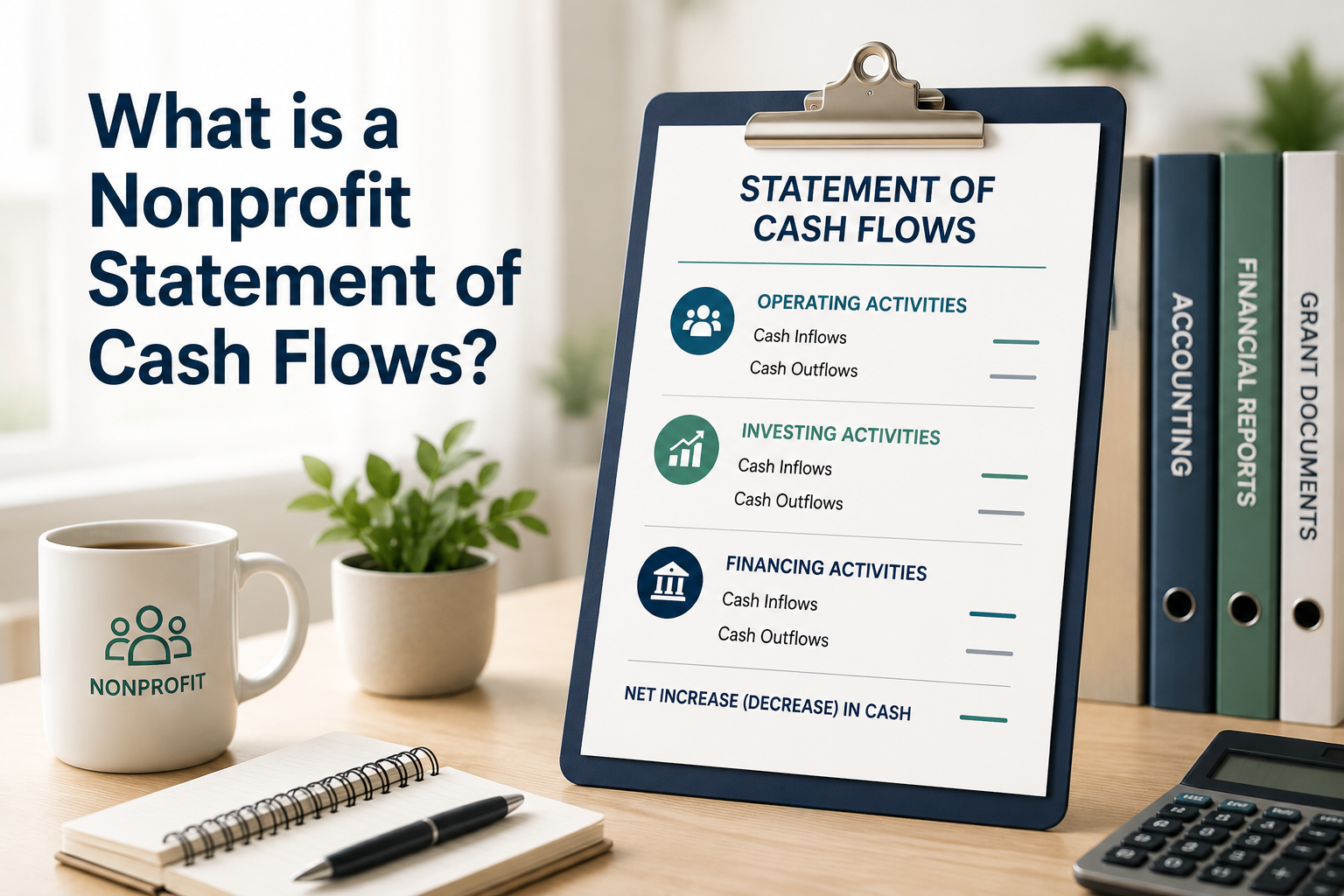
The statement of cash flows tells you where cash came from and where it went during a reporting period. For nonprofits, that clarity matters more than ever because:
- Most nonprofits operate on tight margins and timing matters — when gifts arrive and when bills are due don’t always line up.
- Donors, lenders, and grantors want to see liquidity and how restricted gifts are handled.
- Auditors and GAAP expect a clear reconciliation between accrual‑based results and actual cash movement.
Think of the statement as the organization’s short‑term reality check. The statement doesn’t replace your statement of activities (which shows revenues and expenses on an accrual basis) or the balance sheet (which shows financial position); however, it complements them by revealing cash timing, sources of cash for capital expenditures or debt repayments, and whether operations generate or consume cash.
Why stakeholders care: board members want to know if you have an operating cushion; program staff want to know whether a restricted grant can support hiring; bankers want to see cash available for debt service. Together, the cash flow statement answers all of those questions succinctly.
(Short wrap: if your statement of activities says “we had a surplus” but your cash flow shows “negative from operations,” that’s a red flag — time to reconcile and explain.)
Understanding Operating, Investing, and Financing Activities in Nonprofits
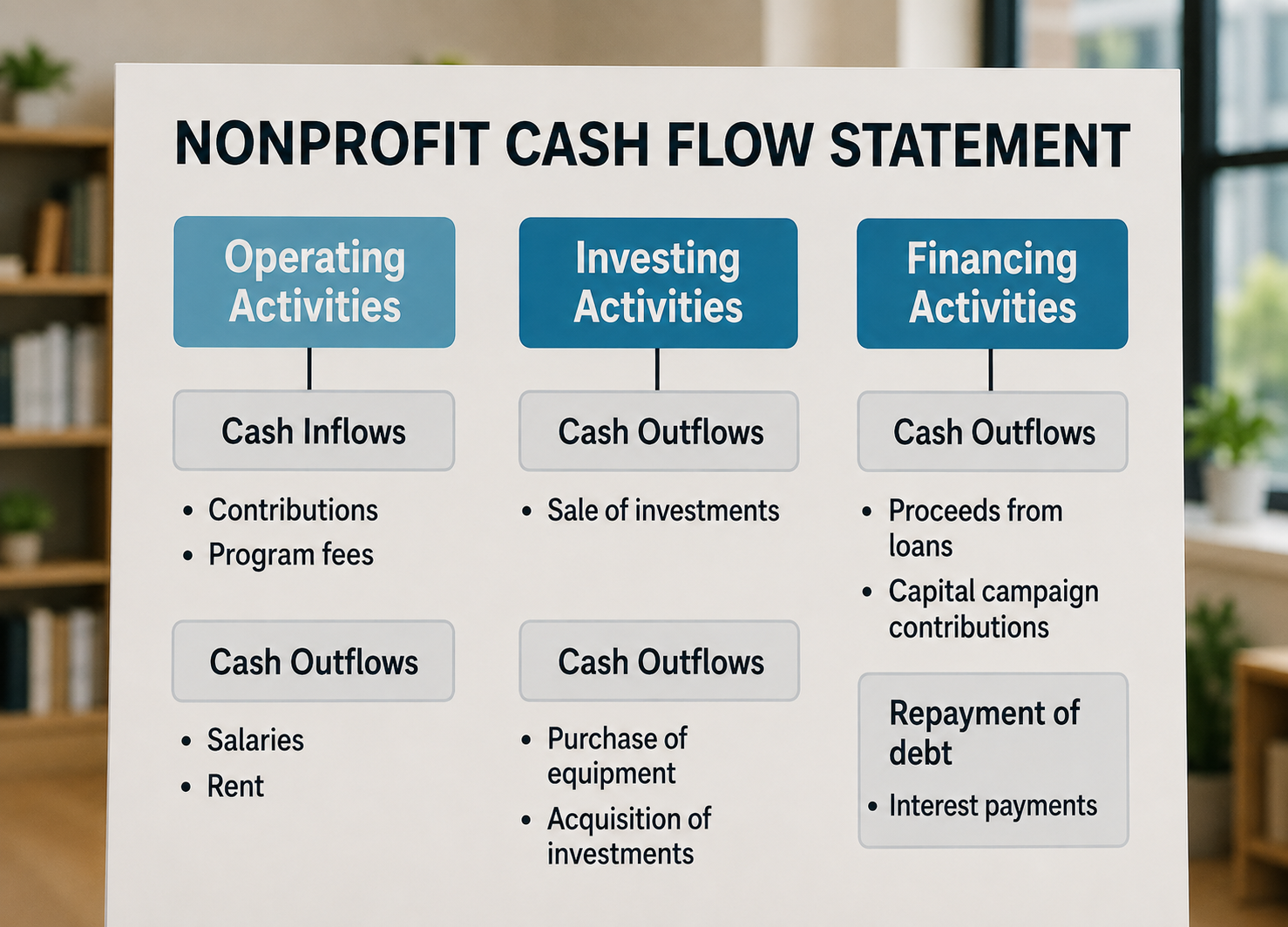
Clear classification is the backbone of a useful cash flow statement. Below are nonprofit‑tailored definitions and examples so you can classify transactions confidently.
Operating Activities
What it is
- Day‑to‑day mission cash inflows and outflows. For nonprofits, operating cash flows include donations and grants used for ongoing programs, program service fees, payment of salaries, rent, utilities — the cash that keeps the mission running.
Typical examples
- Cash receipts from individual donations, membership dues, and unrestricted grants.
- Cash payments to suppliers and vendors for program delivery.
- Cash payroll payments and payroll tax remittances.
- Cash receipts from program service fees, tuition, or ticket sales.
Nuance nonprofit leaders miss
- Pledges or grants recorded on the statement of activities but not yet collected are accrual items. So, only cash receipts go on the cash flow statement.
- Donor‑restricted contributions that are used for current operations are reported in operating activities when the cash is spent on operating needs.
Wrap‑up line: Operating cash shows whether the mission can cover routine costs from actual cash.
Investing Activities
What it is
- Cash flows related to long‑term assets and investments: purchases and sales of property, equipment, and investment securities.
Typical examples
- Cash spent to buy a delivery van or computer equipment.
- Cash proceeds from sale of a building or sale of long‑term investments.
- Cash used to purchase or redeem investments.
Restricted funds and capital purchases
- When donors give money specifically to buy a capital asset (for example, a new van), classification can be tricky. The cash movement tied to purchasing the asset shows in investing activities; meanwhile, the donor gift may appear as a financing or investing inflow depending on presentation and whether the funds were designated for long‑term purposes. Check GAAP guidance and consult your CPA if the classification affects key covenant or reporting requirements.
Wrap‑up line: Investing cash reveals whether you’re adding capacity (buying assets) or monetizing investments.
Financing Activities
What it is
- Cash flows that change the organization’s capital structure: borrowing and repaying loans, proceeds from long‑term debt, and some forms of donor support tied to long‑term financing.
Typical examples
- Cash proceeds from a bank term loan or mortgage.
- Principal repayments on long‑term debt.
- Cash transfers from board‑designated reserves or payments related to capital leases.
- Donor cash given to support long‑term projects — often presented as financing if intended to fund capital structure rather than operations.
Nuance nonprofit leaders miss
- Interest paid: under GAAP, interest paid is typically shown in operating activities for nonprofits (unless you choose otherwise and disclose the policy), while principal payments are financing.
- Donor‑restricted capital gifts: classification may vary — so, check your accounting policy and be ready to explain the treatment.
Wrap‑up line: Financing activities explain where long‑term money came from and how debt and capital were managed.
How to Prepare a Nonprofit Statement of Cash Flows: Step-by-Step Guide
Follow these steps to create a cash flow statement that your board can actually use.
Gather Financial Data
Collect the following:
- Two balance sheets (beginning and ending of the period).
- Statement of activities (income statement for the period).
- Bank statements and canceled checks.
- Schedules for fixed assets and long‑term debt.
- Details on restricted gifts and pledges collected during the period.
Practical tip: reconcile bank statements to the general ledger before you begin — that prevents obvious errors from polluting the cash flow analysis.
Choose Your Reporting Method (Direct vs Indirect)
Decide whether you’ll report operating cash flows using:
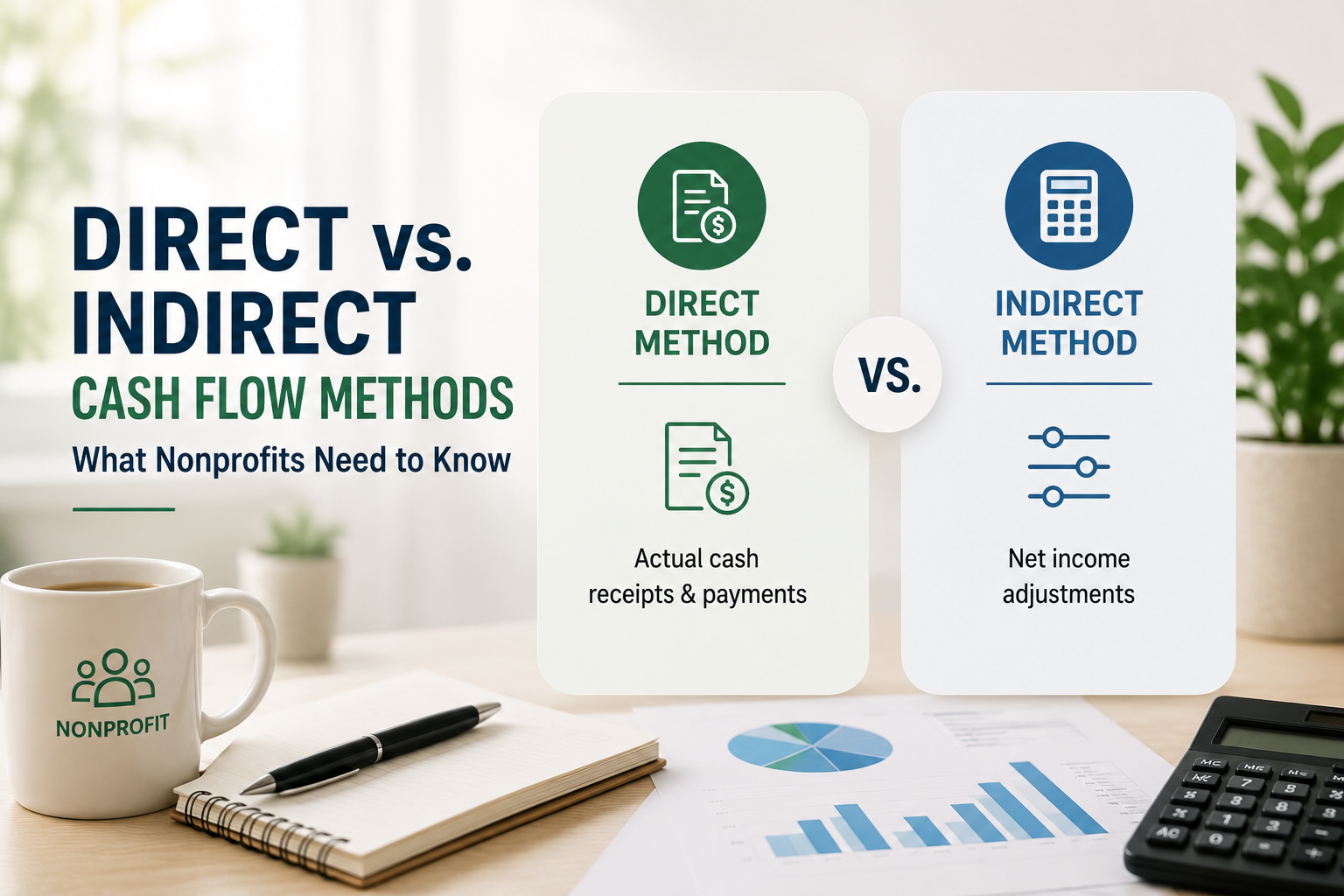
- Direct method — lists actual cash receipts and cash payments.
- Indirect method — starts with change in net assets (i.e., accrual surplus/deficit) and adjusts for noncash items and working capital changes.
Both are permitted under U.S. GAAP; most nonprofits use the indirect method, but the direct method gives more visibility into the actual cash lines donors and managers care about. If you use direct, GAAP asks for a reconciliation to the indirect format (or an indirect reconciliation if you use direct), so expect one extra step.
Classify Cash Flows
Using your source documents, assign each cash movement to operating, investing, or financing per the definitions earlier. Use a simple checklist:
- Did the cash support day‑to‑day programs? → Operating
- Did the cash buy/sell a long‑term asset or investment? → Investing
- Did the cash create or change long‑term financing? → Financing
Example red flag to watch for: “Restricted for capital” gift that is received and then used immediately to buy equipment. Consequently, the inflow and the outflow should each be placed consistently and explained in notes.
Calculate Net Cash Changes and Reconcile
- Sum cash provided (or used) by operating, investing, and financing activities.
- Net change in cash = Operating + Investing + Financing.
- Ending cash balance = Beginning cash balance + Net change in cash.
- Reconcile your ending cash balance to the bank statement and the balance sheet cash line.
Reconciliation tip: If reconciled beginning/ending cash balances don’t match, trace differences to timing items like deposits in transit, outstanding checks, or misposted transactions.
Wrap‑up: Accurate classification and reconciliation are what make the cash flow statement credible.
Direct vs Indirect Cash Flow Methods: What Nonprofits Need to Know
The Direct Method Explained
What it shows
- Actual cash inflows (cash from donors, program fees, grants collected) and cash outflows (cash paid to vendors, payroll cash paid, interest paid).
Why use it
- Provides transparency about actual cash receipts and payments — useful for managers and program directors focused on cash timing.
Drawbacks
- Requires more detailed cash tracking (bank-level aggregation by type) which can be heavier for organizations without robust bookkeeping systems.
The Indirect Method Explained
What it shows
- Starts with change in net assets (from statement of activities) and adjusts for noncash items (depreciation, amortization, unrealized gains/losses) and changes in working capital (receivables, payables, inventory).
Why use it
- Easier to prepare from existing accrual records; explains differences between accrual accounting results and cash movement.
Drawbacks
- Less granular visibility into actual cash receipts and payments.
Comparison and Pros/Cons for Nonprofits
- Transparency: Direct > Indirect
- Ease of preparation: Indirect > Direct
- Usefulness to program managers: Direct > Indirect
- Common in practice: Indirect is more common because accounting systems produce accrual reports easily.
Rule of thumb: If you have reliable cash receipts and disbursement tracking (many modern accounting systems do), use the direct method for internal reporting and keep the indirect reconciliation for GAAP‑style external reporting.
Examples of Each Method (Nonprofit Focused)
Indirect method snapshot (condensed)
| Line item | Amount |
|---|---|
| Change in net assets | 30,000 |
| Add back: Depreciation | 10,000 |
| (Increase) in pledges receivable | (15,000) |
| Decrease in accounts payable | (5,000) |
| Net cash provided by operating activities | 20,000 |
| Cash used in investing (equipment purchase) | (25,000) |
| Cash provided by financing (loan proceeds less principal repayments) | 42,000 |
| Net increase in cash | 37,000 |
| Beginning cash | 20,000 |
| Ending cash | 57,000 |
Direct method snapshot (condensed)
| Cash receipts and payments | Amount |
|---|---|
| Cash received from donors and program fees | 277,000 |
| Cash paid to suppliers | (120,000) |
| Cash paid for payroll | (110,000) |
| Cash paid for interest | (4,000) |
| Net cash provided by operating activities | 43,000 |
| Cash used in investing | (25,000) |
| Net cash provided by financing | 42,000 |
| Net increase in cash | 60,000 |
| Beginning cash | 20,000 |
| Ending cash | 80,000 |
(These are illustrative numbers — adapt to your chart of accounts and reporting needs.)
Wrap‑up: Both methods reach consistent net change in cash, but the direct method makes day‑to‑day cash flows obvious.
Sample Nonprofit Statement of Cash Flows: Walkthrough and Template
Example Statement (Indirect Method)
Use the previous indirect snapshot as a template for annual reporting. Also, add footnotes that explain major reconciling items (large pledge timing changes, significant donations for capital projects, and new debt agreements). Disclose accounting policy for classification of restricted contributions.
Example Statement (Direct Method)
If you prepare monthly cash reports for management, a compact direct statement is often more useful. For clarity, break down receipts by major source (individual donations, foundation grants, program fees) and payments by major expense type (payroll, program suppliers, rent). As a result, this makes forecasting and short‑term decisions easier.
How to Use Templates for Your Organization
- Monthly for management: produce a direct method summary plus a short rolling 3–6 month cash forecast.
- Quarterly for the board: use indirect method for GAAP reconciliation and add narrative explaining major timing differences.
- Annual external reporting: follow GAAP guidance and include notes about restricted funds and any classification decisions.
Practical accuracy tips
- Keep a cash receipts journal or use software tags to identify restricted vs unrestricted receipts on deposit.
- Reconcile payroll clearing accounts monthly — payroll timing often causes confusion.
- Maintain a fixed asset schedule with accumulated depreciation to reconcile noncash depreciation adjustments.
Wrap‑up: A simple template plus disciplined month‑end routines makes this report painless.
Best Practices for Managing Nonprofit Cash Flow
Importance of Cash Flow Forecasting and Reserves
- Maintain an operating reserve policy (e.g., 3–6 months of operating costs) and present reserve status to the board annually.
- Produce a rolling 3‑month cash forecast and update it weekly if cash is tight.
- Use scenario planning: what happens if a major grant is delayed 30 or 60 days?
Handling Restricted vs Unrestricted Funds
- Track restricted receipts separately from the moment they arrive.
- Spend restricted cash only for its donor‑specified purpose or after donor release.
- Communicate clearly in board reports how restricted cash and pledges affect available liquidity.
Tips for Improving Cash Liquidity and Sustainability
- Timely invoicing and active pledge collection procedures reduce receivable buildups.
- Negotiate payment terms with major vendors (net 45 instead of net 30) to ease temporary tightness.
- Maintain a committed line of credit sized to bridge predictable timing gaps, not to fund ongoing operations.
- Coordinate fundraising and program managers so large receivable inflows align with planned spending.
Wrap‑up: Treat cash like program staff — schedule it, protect it, and measure its impact.
Final Thoughts and Next Steps
The statement of cash flows makes the invisible visible: it shows whether your organization’s operations actually generate the cash needed to deliver on mission. Use the indirect method if your current accounting system makes it easy, but consider producing a direct‑method monthly report for operational transparency. Overall, track restricted gifts carefully, reconcile monthly, forecast consistently, and present cash metrics to your board regularly.
If you want help tailoring templates or reviewing classification policies (especially around restricted capital gifts or complex financing), consider bringing in a nonprofit specialist. Telos CPAs, a firm dedicated exclusively to serving nonprofits, can review your cash flow presentation and help set up reporting that makes your board meetings shorter and your decisions clearer.
Quick checklist before your next board packet
- Do you have beginning and ending cash reconciled to the bank? Yes/No
- Have you classified restricted receipts and shown how they were used? Yes/No
- Is there a one‑page forecast for the next 3 months? Yes/No
- Do you have a brief narrative explaining major timing variances? Yes/No
Still reading? Good. Now go make your cash statement the most useful page in your next board packet.