
Short answer up front
- Net assets now display in two classes: without donor restrictions and with donor restrictions (goodbye unrestricted, temporarily restricted, permanently restricted labels).
- The statement of activities must show changes by donor restriction class.
- Expense reporting requires both functional and natural classifications (on the face or in the notes).
- In addition, new and clearer liquidity disclosures are required, including quantitative amounts of financial assets available within one year and management’s liquidity plans.
- Effective date: ASU 2016 14 was issued in 2016 and is effective for fiscal years beginning after December 15, 2017; early adoption is permitted. However, check with your auditor for exact timing for your organization.
Overall, this guide translates the standard into practical steps, examples, and sample disclosure language you can adapt for your notes and board materials. One natural mention: Telos CPAs focuses exclusively on nonprofits and can help if this feels like too much to do in-house. Now let’s get specific.

Overview of FASB ASU 2016 14 for Nonprofits
Background and Purpose of the Update
FASB issued Accounting Standards Update (ASU) 2016 14 to improve the usefulness and understandability of nonprofit financial statements. The update had two main goals: simplify presentation of net assets so users (donors, lenders, boards) more clearly see what resources are available, and increase transparency about liquidity so stakeholders can assess an organization’s ability to meet cash needs.
Why it matters: prior three-tier net asset labels (unrestricted, temporarily restricted, permanently restricted) were confusing to many users. As a result, the change reduces that confusion and requires additional note disclosures so the organization tells a fuller liquidity story.
Effective Dates and Applicability
ASU 2016 14 was issued in 2016. The standard became effective for fiscal years beginning after December 15, 2017, with early adoption permitted. Also, implementation may involve restating comparative financial statements to the new presentation (discuss this with your auditor). If your organization still uses the old presentation, start planning a transition — it’s largely a presentation and disclosure change, but it requires board and staff alignment.
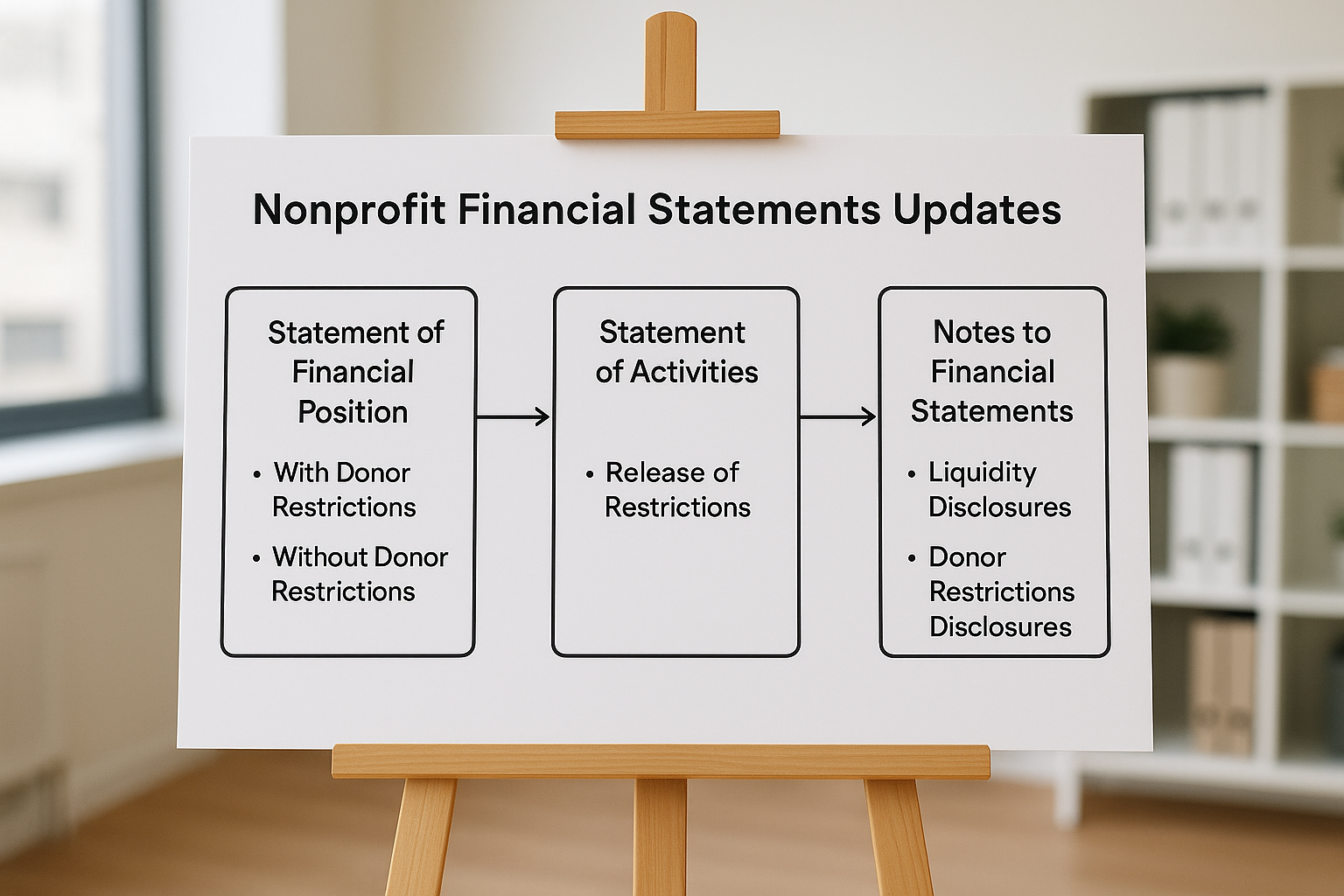
Net Asset Classification Changes Under ASU 2016 14
Previous Net Asset Classes vs New Two Class Model
Before ASU 2016 14:
- Unrestricted
- Temporarily restricted
- Permanently restricted
After ASU 2016 14:
- Net assets without donor restrictions
- Net assets with donor restrictions
Table — Before and After Net Asset Labels
| Before ASU 2016 14 | After ASU 2016 14 |
|---|---|
| Unrestricted | Without donor restrictions |
| Temporarily restricted | With donor restrictions |
| Permanently restricted | With donor restrictions |
Important: The substance of donor-imposed restrictions didn’t change — funds permanently restricted (e.g., endowment principal) are now reported in the single “with donor restrictions” class, but you still disclose the nature of those restrictions in the notes.
Definition of “With Donor Restrictions” and “Without Donor Restrictions”
- With donor restrictions: Net assets subject to donor-imposed restrictions that can be time-based (available after a specified date), purpose-based (only for program X), or perpetual (donor requires assets be maintained in perpetuity). The restriction may be released (and reclassified to without donor restrictions) when the restriction expires or purpose is met.
- Without donor restrictions: Net assets available for general use by the organization. This also includes board-designated funds (also known as board-designated net assets) — these are internally designated and not legally restricted by donors.
In short, be precise in labeling. Specifically, internally designated funds belong in “without donor restrictions” and must be described in the notes.
Board Designated vs Donor Restricted Funds
Common confusion: board designation is not a donor restriction. For example, if the board sets aside funds for a reserve or future capital project, those funds remain without donor restrictions because the board can change that designation. But ASU 2016 14 asks you to disclose board-designated amounts so users understand how much the board has internally limited for specific purposes.
Practical distinction:
- Donor restriction: legal or contractual; can’t be altered by the board or management without donor approval or a court.
- Board designation: internal intent; informative but not legally binding.
Practical Implications for Nonprofit Reporting
- Restate comparative statements if you want consistent comparability across years (consult your auditor). For clarity, many organizations show both years under new classification.
- Update chart of accounts and reporting templates so net asset classes and reclassifications (release of restrictions) post correctly.
- At the same time, train development, finance, and program staff so revenue recognition and restriction tracking align — e.g., when a pledge is received as “for program Y next year,” classify as with donor restrictions until the time restriction lapses.
- Finally, add clear note disclosure describing the types of donor restrictions, board designations, and how releases of restrictions occur (time, expenditure, or satisfaction).
Example: A $50,000 donation for a scholarship program in Year 1 that is only to be used in Year 2 remains “with donor restrictions” until Year 2 when the scholarship is awarded and restriction is satisfied; at that point it’s reclassified to “without donor restrictions.”

Financial Statement Presentation Changes for Nonprofits
Statement of Activities – Showing Changes by Donor Restriction
ASU 2016 14 requires the statement of activities to present changes in net assets by donor restriction class (with and without donor restrictions) and a total column. As a result, your statement of activities will have at least two columns:
- Without donor restrictions
- With donor restrictions
- Total
In practice, you must show:
- Revenues and gains (by donor restriction class)
- Net assets released from restrictions (amounts reclassified from with donor restrictions to without)
- Expenses (presented and totaled by donor restriction class as appropriate)
- Transfers between classes, if any
Simple mockup (condensed) of the statement of activities layout:
| Without Donor Restrictions | With Donor Restrictions | Total | |
|---|---|---|---|
| Contributions | 500,000 | 200,000 | 700,000 |
| Program service revenue | 400,000 | — | 400,000 |
| Net assets released from restrictions | 150,000 | (150,000) | — |
| Total revenue and support | 1,050,000 | 50,000 | 1,100,000 |
| Expenses | (900,000) | — | (900,000) |
| Change in net assets | 150,000 | 50,000 | 200,000 |
Expense Reporting – Natural and Functional Classification
Notably, under ASU 2016 14, you must present expenses by both function (program services, management and general, fundraising) and natural classification (salaries, rent, supplies). You can satisfy this requirement in either of two ways:
- On the face of the statement of activities (or a combined statement of activities and functional expenses), or
- In a separate schedule in the notes that shows the allocation of natural expense categories to functions.
Practical implementation:
- Ensure payroll and general ledger coding capture both function and natural classification (e.g., payroll expense coded to “program – salaries” vs “administration – salaries”).
- Use allocation methods that are reasonable, documented, and consistent (time studies, employee FTE allocation, square footage for occupancy costs).
- Include a note describing allocation methods and any significant judgments.
Statement of Cash Flows – Presentation Options and Enhancements
This standard did not change the cash flow classification requirements (operating, investing, financing) but highlighted presentation clarity. You may use either direct or indirect method; either way, both are acceptable. However, the standard emphasizes the need for clear note disclosures of cash equivalents and restricted cash, and how cash fits into the liquidity narrative.
As a result, consider these action items:
- Reconcile cash and cash equivalents and restricted cash balances and disclose them clearly.
- If you present restricted cash separately, explain whether it’s included in the cash line in the statement of cash flows or presented separately.
Required Note Disclosures Related to Financial Statements
This update expanded note disclosure expectations. In particular, required disclosures include:
- Description of the two net asset classes and types of donor restrictions.
- Composition of net assets with donor restrictions (e.g., endowment, time-restricted pledges).
- Board-designated amounts included in net assets without donor restrictions, if any.
- Policy on expenses by natural and functional classification and allocation methods.
- Liquidity and availability of resources (covered in the next section).
Overall, be explicit and succinct in notes — users read the notes for exactly these clarifications.

Liquidity Disclosures Requirements for Nonprofits
Explanation of Liquidity and Cash Availability Concepts
Liquidity in nonprofit reporting is about the organization’s ability to meet cash needs as they come due within one year. Under ASU 2016 14, both qualitative and quantitative disclosure so readers can assess short-term liquidity and how restrictions affect available resources.
Most importantly, financial assets available do not equal total net assets. Donor-imposed restrictions and board designations affect what management can actually spend.
Required Disclosure Elements Under ASU 2016 14
At a minimum, your liquidity disclosure should include:
- First, a quantitative measure: financial assets available for general expenditure within one year (cash, receivables, marketable securities), net of amounts not available because of donor restrictions or internal designations.
- Second, a narrative about how the organization manages liquidity: use of reserves, lines of credit, timing of receivables, investment allocation intended to meet near-term needs.
- Finally, any board-designated amounts that management does not consider available for general expenditure.
A compact disclosure example might state: “As of June 30, 20XX, the organization had $X of financial assets available within one year, of which $Y was donor-restricted for long-term purposes and $Z was board-designated for operations. Management expects to meet cash needs for the next 12 months through a combination of operating cash, an available line of credit, and planned fundraising.”
Board Designations and Liquidity Management
Board-designated reserves should be disclosed separately so users can see how much of the “without donor restrictions” balance management expects to use for operations versus hold back. If the board has a formal reserve policy, summarize it: target reserve level, funding method, and withdrawal criteria.
Also disclose any lines of credit or borrowing arrangements and whether they are drawn. In fact, that matters a lot to creditors reviewing liquidity.
Sample Language and Presentation Examples
Here’s a sample quantitative table for the liquidity note:
| Amount | |
|---|---|
| Cash and cash equivalents | 250,000 |
| Accounts receivable (net) | 100,000 |
| Short term investments | 150,000 |
| Less donor restricted to long term use | (120,000) |
| Less board designated for capital projects | (80,000) |
| Financial assets available within one year | 300,000 |
Sample narrative (adapt for your facts): “Financial assets available for general expenditure within one year of the balance sheet date consist of cash and cash equivalents, accounts receivable, and short term investments totaling $500,000. Of this amount, $150,000 is subject to donor restrictions that limit its use to long-term purposes and $50,000 has been designated by the Board for capital replacement. Management expects that available financial assets, together with anticipated cash receipts, planned appropriation of board designated funds, and an undrawn line of credit of $200,000, will be sufficient to cover operating needs for the next 12 months.”
Practical Implementation Checklist
Below is a step-by-step checklist to guide staff and the board through ASU 2016 14 implementation.
- Start by inventorying current net asset accounts and donor restriction terms. Identify any inconsistencies between donor documents and accounting.
- Next, update chart of accounts and financial statement templates to reflect “without donor restrictions” and “with donor restrictions.”
- Then, decide whether to restate prior year comparatives. Consult your auditor and document the decision.
- Also, ensure revenue, pledge, and grant tracking systems capture restriction type and release conditions.
- Update payroll and expense coding to capture both natural and functional classifications; document allocation methods.
- Draft liquidity disclosures: compute financial assets available within one year and prepare narrative on liquidity management and board designations.
- Prepare sample statement of activities in new column format and reconcile reclassifications (e.g., net assets released from restrictions).
- Review board minutes and policies to identify board-designated amounts and whether board wants them disclosed.
- Additionally, train development, program, and finance teams on coding and reporting changes.
- Discuss changes with auditors early; obtain sign-off on presentation, comparative numbers, and disclosure language.
- Communicate changes to stakeholders: include a brief explanatory note in your annual report and consider a one-page summary for the board or key donors.
Use this checklist as a living document — adapt exact steps to your size and complexity.
Frequently Asked Questions
Q: Do we have to restate prior year financials? A: Not required in all cases, but many organizations present comparative statements under the new presentation for clarity. Your auditor will advise whether restatement or retrospective presentation is appropriate for your situation.
Q: Where do board-designated funds show up? A: They remain in net assets without donor restrictions but should be described in a note that quantifies the amount and explains the designation purpose.
Q: Can we include the expense allocation schedule in the notes instead of on the face? A: Yes. In fact, ASU allows presenting expenses by function and nature either on the face of the financial statements or in the notes.
Q: How specific should the liquidity narrative be? A: Be specific enough to show how you’ll meet known cash needs (sources like fundraising, lines of credit, planned draws from investments) and disclose any constraints. However, avoid speculative projections.
Q: Who should sign off on the new disclosures? A: Finance leadership and the executive director should approve draft disclosures; the audit committee should review, and the auditor will review for technical compliance.
Wrap up and Next Steps
In short, ASU 2016 14 simplified how nonprofits label net assets but raised the bar for transparency — especially about liquidity and expense allocation. The technical changes are manageable with good internal controls: update your chart of accounts, document allocation methods, train staff, and draft clear notes that explain board designations and available financial assets.
If this feels like a lot (it is), plan the work into payroll/GL updates, board approvals, and an auditor review. When you’re ready, consider having someone with nonprofit accounting expertise (like Telos CPAs) review your drafts — a fresh set of eyes often catches classification or disclosure items that are easy to miss.
Want a one page checklist or a sample disclosure tailored to your organization’s facts? Reach out to your auditor or a nonprofit-focused CPA for a quick review before finalizing your financial statements.