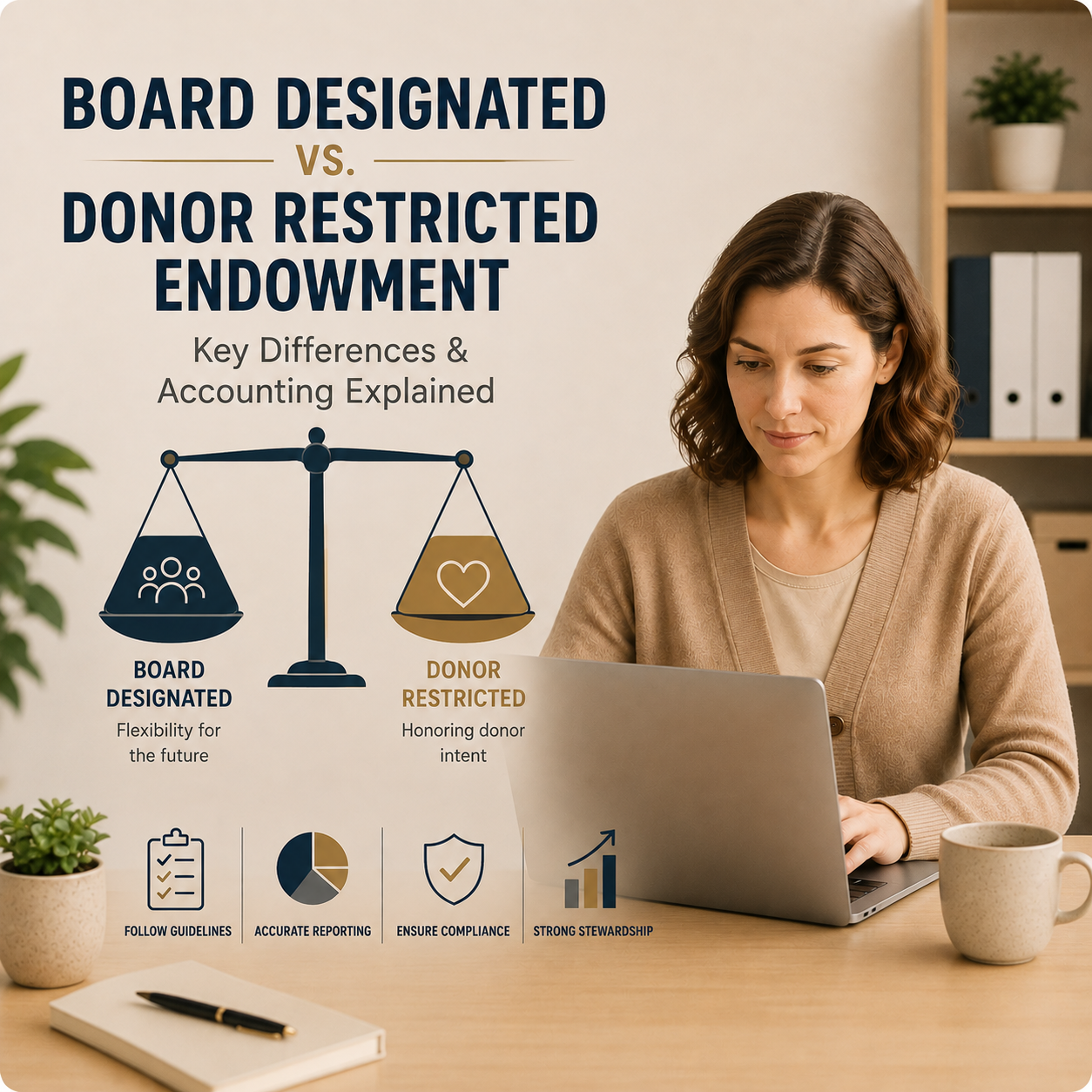
Read this if you’re an executive director, finance director, treasurer, or board member who must answer: How much can we spend from our endowment this year? What do we do if the fund is underwater? How do we document that the board acted prudently? You’ll get straightforward explanations, sample policy text you can adapt, an underwater scenario with numbers, and a compliance checklist to use in your next board packet.

Understanding UPMIFA and Its Importance for Nonprofits
What is UPMIFA?
UPMIFA stands for the Uniform Prudent Management of Institutional Funds Act. It’s the model law most states adopted to replace the older Uniform Management of Institutional Funds Act. In short, UPMIFA sets a legal framework asking board fiduciaries to manage and spend donor restricted institutional funds prudently — balancing current needs against preserving funds for perpetual purpose.
Coverage: UPMIFA applies to donor-restricted institutional funds (typically endowments) held by charities, foundations, and similar entities. It does not convert donor restrictions into trustee discretion; it gives the board a structured prudence standard when investing and appropriating funds.
Note: States adopted UPMIFA with variations. Always confirm how your state implemented particular provisions and consult counsel for legal questions.
Key Provisions and Board Duties Under UPMIFA
UPMIFA replaced bright-line rules (like rigid “preserve corpus at all costs”) with a fact-specific prudence standard. That means the board’s decisions are judged against the process and factors the statute requires rather than a single fixed rule.
The most important board duties under UPMIFA are:
- Apply a prudence standard when investing and spending. Decisions must be made in good faith, with reasonable care, skill, and caution.
- Also, consider the statutory prudence factors (see next section) before appropriating funds for expenditure.
- In addition, maintain written policies: a spending policy and an investment policy are best practices and often expected by auditors and donors.
- Similarly, document deliberations and the factual basis for spending decisions in board minutes.
- Finally, disclose relevant information in financial statements and tax filings as required by accounting standards and the Form 990 instructions.
Why this matters: Boards that treat UPMIFA as a checklist rather than a decision framework risk under- or overspending, donor complaints, and in extreme cases, legal scrutiny from state regulators.
The Seven Prudence Factors (and what they mean)
UPMIFA lists factors boards should consider when appropriating funds. Summarized into plain language, they are:
- Duration and preservation of the fund — Is this intended to be perpetual?
- Purposes of the institution and the fund — Does spending align with donor intent?
- General economic conditions — What’s the macroeconomic outlook?
- Possible effect of inflation/deflation — Will spending erode purchasing power?
- Expected total return from income and appreciation — What total return can be expected over time?
- Other resources of the institution — Can other funds cover mission needs if endowment is preserved?
- The institution’s investment policy — Is asset allocation consistent with spending needs?
Putting these factors into practice means the board should document which factors were considered and why a particular spending appropriation was reasonable given those considerations.
Crafting Effective Endowment Spending Policy Rules
Purpose and Importance of Spending Policies
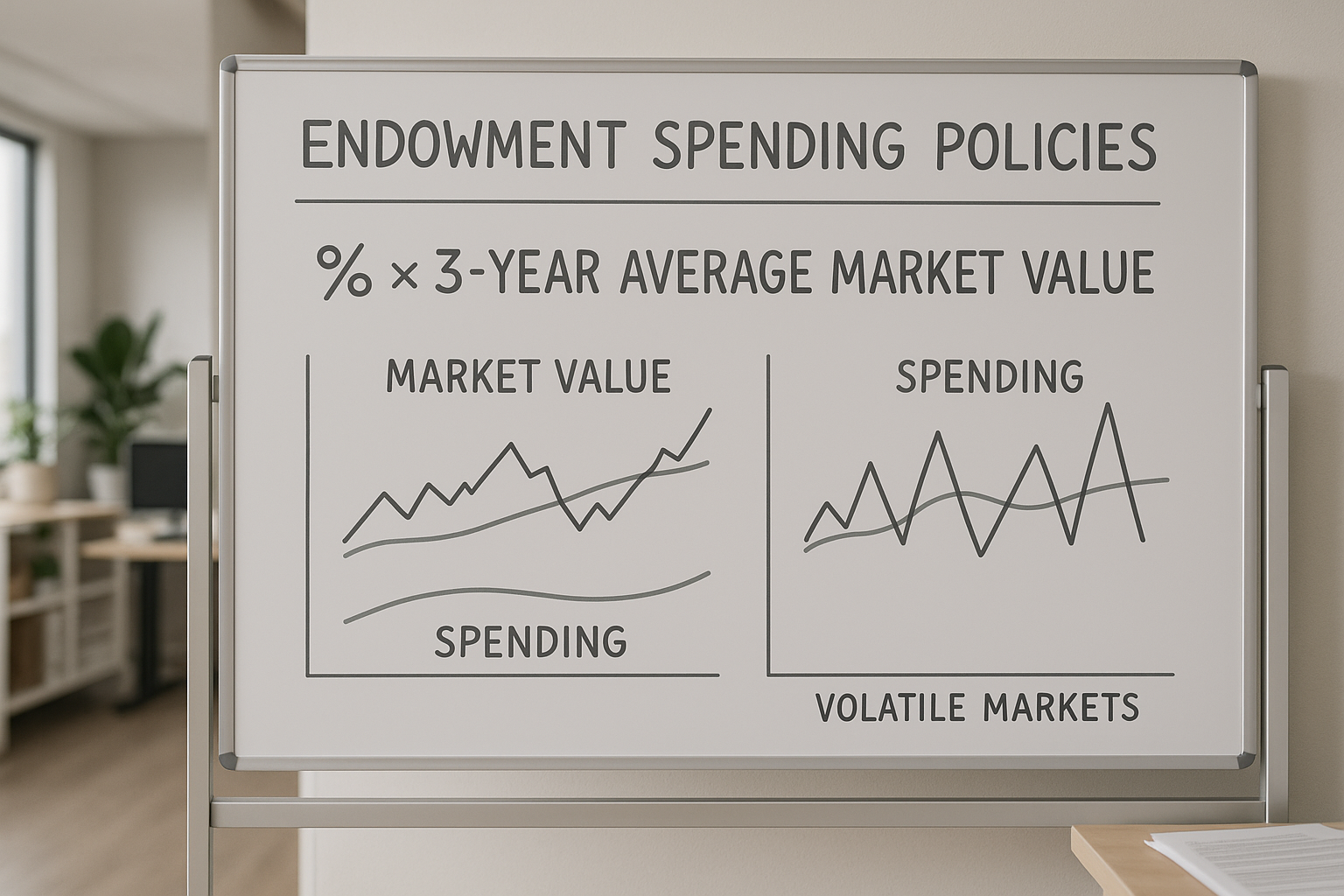
A written spending policy does two jobs: it gives predictable funding to program leaders and it demonstrates that the board is applying UPMIFA’s prudence standard. The policy translates abstract prudence into repeatable, defensible mechanics — a formula and guardrails to determine annual appropriation.
Overall, a good policy aligns spending with donor intent, preserves purchasing power over time, and reduces ad-hoc decisions after market turbulence.
Common Spending Rate Formulas and Guidelines
Spending policies commonly use one of these approaches:
- Percent-of-market-value: Take a percentage of the current market value each year (simple but volatile).
- Averaging method (most common under UPMIFA influence): Apply a set percentage to the average fair market value over the prior 3–5 years to smooth market swings.
- Hybrid floor/ceiling: A policy might set a target rate (e.g., 4.25%) with allowable bands (3%–5%) and an override mechanism for extraordinary circumstances.
Typical ranges: In practice, many charities set long-term spending targets between 3% and 5% of market value, applied to a trailing 3- or 5-year average to protect the corpus from sequence-of-returns risk. That isn’t a legal rule — it’s a common governance choice that balances current spending with preservation.
Example calculation using a 3-year trailing average and a 4% spending rate:
- Year-end FMV: Year 1 = $1,000,000; Year 2 = $1,100,000; Year 3 = $900,000
- 3-year average = ($1,000,000 + $1,100,000 + $900,000) / 3 = $1,000,000
- Spending allowance at 4% = $1,000,000 x 4% = $40,000
As a result, that smoothing keeps Year 3’s market dip from forcing a big cut in program funding.
Role of the Board in Approving and Reviewing Spending Policies
The board should:
- Approve the spending policy in a formal vote and review it annually.
- Additionally, require a finance or investment committee to model the policy’s long-term effect on each material endowment.
- Also, revisit the policy after significant market moves, changes in liquidity needs, or when a new large restricted gift arrives.
Addressing Inflation and Market Volatility in Spending Rules
Two practical levers help protect purchasing power:
- Indexing: Add a small inflation adjustment (e.g., CPI or fixed basis points) to the spending rate formula.
- Real-return focus: Alternatively, evaluate long-term expected total returns rather than recent income alone when setting rates.
But beware: automatic inflation adjustments can increase volatility in stressed markets. Even so, use them thoughtfully and document the board’s reasoning.
Managing Underwater Endowments under UPMIFA
What Does It Mean When an Endowment is Underwater?
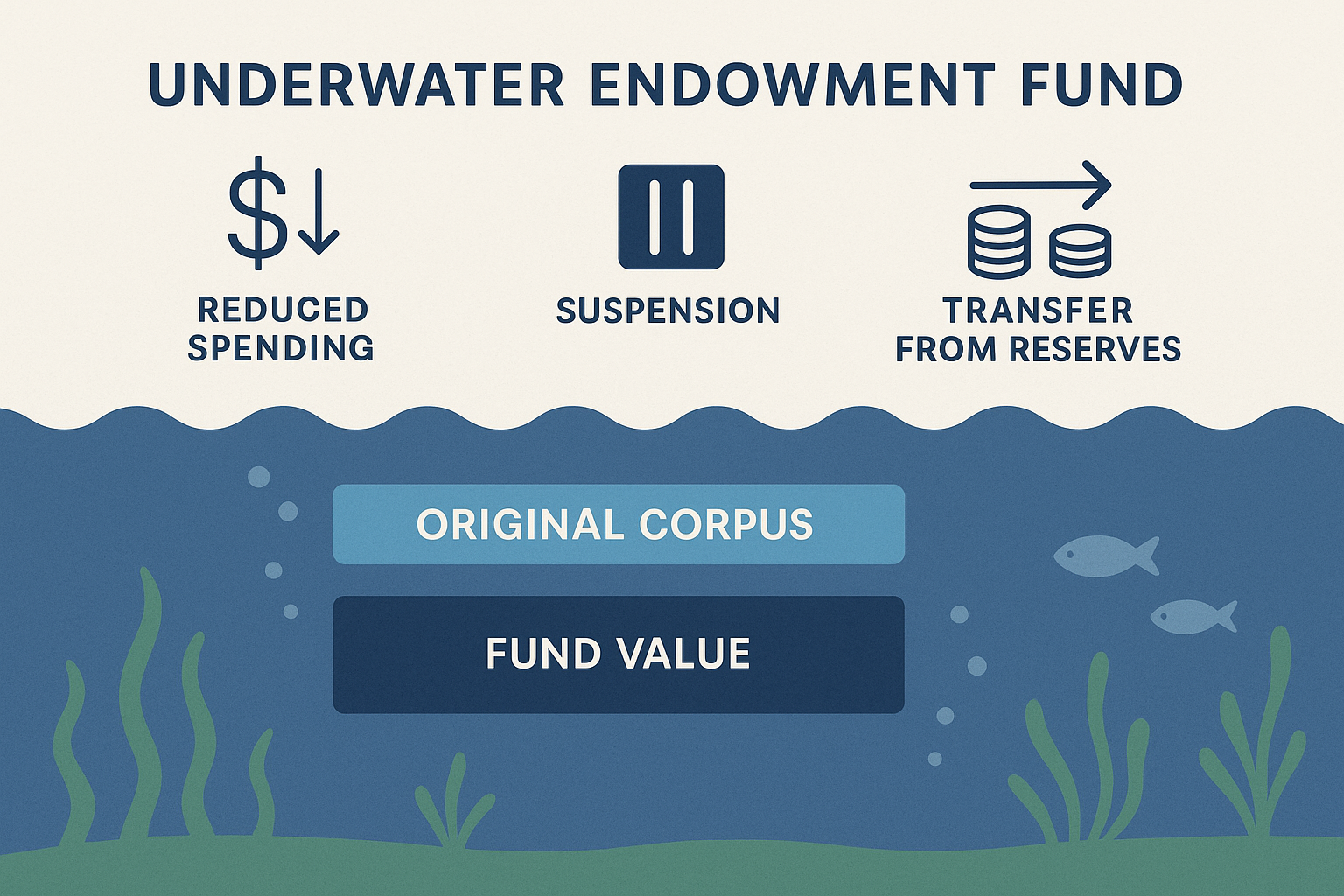
An endowment is “underwater” when its current fair market value is less than the original gift (corpus) required by the donor. For example, an original restricted gift of $100,000 currently valued at $85,000 is underwater by $15,000.
Underwater funds raise legal and stewardship questions: Should you suspend spending? Can you spend at all? The law helps guide, but it doesn’t automatically forbid spending.
UPMIFA Guidance on Underwater Endowment Spending
UPMIFA permits boards to appropriate (spend) from underwater funds if doing so is prudent under the seven factors. That means spending is not banned outright, but extra caution is required. Regardless, boards must document why spending an underwater endowment is consistent with donor intent and the statutory prudence factors.
State variations: Some state adoptions include default protections for underwater funds; others give broader discretion. So, confirm your state law.
Practical Strategies for Managing Underwater Funds
Options boards commonly consider:
- Temporary suspension of spending from the underwater fund until it recovers — good for protecting corpus but can harm programs that depend on the funds.
- Alternatively, reduced spending rather than full suspension — apply a lower percentage or use a sliding scale tied to recovery thresholds.
- Similarly, transfer from unrestricted reserves for mission-critical spending — preserve donor intent while keeping programs funded.
- Seek donor consent to modify restrictions or release corpus (rare but sometimes feasible).
- Finally, adjust investment policy to focus on growth vs. income, considering liquidity needs and risk tolerance.
Underwater scenario with numbers and decision path:
- Corpus: $100,000 (original gift)
- Current FMV: $80,000 (underwater by $20,000)
- Prior policy: 4% of 3-year trailing average
- Finance committee analysis: Expected recovery time under current allocation ~4 years, but immediate program needs require some funding.
Decision options:
- Full suspension: Spend $0 this year — protects corpus but program loses $4,000 expected income.
- Reduced spend: Alternatively, approve 2% ($1,600) from fund now, and supplement $2,400 from unrestricted reserves — balances program needs and corpus protection.
- Temporary loan: Instead, the board authorizes a no-interest internal loan from general reserves to maintain the program, to be repaid once the fund recovers.
Whichever path you choose, document (a) the economic factors considered, (b) the effect on donor intent, (c) alternative funding sources analyzed, and (d) a monitoring plan with recovery triggers.
Documenting Board Decisions and Compliance Steps
Overall, good records are the board’s best defense. At minimum, minutes should record:
- The market valuation date and source of valuation.
- Which prudence factors were considered and how (brief bullet points are fine).
- The recommended spending amount and rationale.
- Any dissenting views and the vote outcome.
- Follow-up actions and review dates.
Also retain committee memos, spreadsheets showing calculations, and communication with donors (if any). Together, these records are vital for audits, state inquiries, and future boards.

Implementing a Prudent Spending Endowment Policy
Principles of Prudent Spending for Perpetual Endowments
Make these principles explicit in policy:
- Respect donor intent first.
- Additionally, smooth spending to avoid program disruption.
- Likewise, preserve intergenerational equity — today’s beneficiaries shouldn’t exhaust tomorrow’s support.
- Finally, use a transparent, repeatable formula with a documented override process for emergencies.
Incorporating UPMIFA’s Seven Factors into Policy Language
Below is sample policy language that folds the statutory factors into operating terms — adapt this to your organization and legal counsel review.
Sample policy snippet: “Our board will appropriate from donor restricted endowments only following a written determination that the appropriation is prudent under applicable law. In reaching a determination the board will consider, and document, the following factors: fund duration and preservation; the purposes of the institution and the fund; current and anticipated economic conditions including inflation; expected total return (income plus appreciation); the institution’s other resources and liquidity; and the institution’s investment policy and risk tolerance. The board will apply a spending formula described in Section X and may temporarily deviate from the formula only after documenting extraordinary circumstances and the reasons for the deviation.”
Policy Monitoring, Review, and Board Training
- Review frequency: Formal review annually and whenever markets move more than a predetermined threshold (e.g., 15% decline).
- Monitoring: Finance committee models long-term impacts of the spending formula on each material endowment.
- Training: Provide annual board training on UPMIFA’s prudence factors and the policy’s mechanics, including scenarios on underwater funds.
- Reporting: Include a one-page endowment dashboard in quarterly finance packets showing market value, 3/5 year averages, allowable spend, and percent funded.
Common Pitfalls and How to Avoid Them
- Pitfall: Treating donor-restricted funds like unrestricted. Fix: Tag and report restricted funds separately and train program staff.
- Pitfall: No written policy or outdated policy. Fix: Adopt a formal policy and set a review calendar.
- Pitfall: Failing to document deliberations. Fix: Require a memo and minutes for every appropriation decision, especially overrides.
- Pitfall: Using a single-year market value without smoothing. Fix: Use trailing averages to reduce volatility.
- Pitfall: Assuming a fixed spending cap (like “we always spend 7%”). Fix: Document the rationale for whatever rate you choose and show how it preserves real purchasing power.
Practical Tools You Can Use Tomorrow
UPMIFA Compliance Checklist for Board Packets
- Confirm state adoption details for UPMIFA and any state-specific caveats.
- Present current FMV and trailing average calculations for each endowment.
- Provide recommended appropriation amount with assumptions and sensitivity analysis.
- Document which prudence factors were considered and why.
- Include investment policy compliance summary and liquidity analysis.
- Archive committee memo, valuation source, and minutes of approval.
Sample Spending Policy Table of Contents (short)
- Purpose and scope
- Definitions (corpus, market value, underwater)
- Spending formula and timing
- Underwater fund rules and triggers
- Delegation authority (e.g., finance committee)
- Monitoring, reporting, and review schedule
- Amendment and emergency override process
Short template: If you want a plug-and-play template, use the sample snippet above as your “Determination” clause and add a 2–3 paragraph “Spending Formula” section specifying averaging period and target rate.
Final Steps and Next Actions
UPMIFA is less about a particular percent and more about process: the board must analyze, decide, and document. If your nonprofit lacks a written spending policy, or your current policy hasn’t been stress-tested in a downturn, put this on the next committee agenda. Run the numbers: Specifically, model a 3%–5% range across 3 and 5 year trailing averages and show how each choice affects program funding and corpus sustainability.
If you want a practical next step, schedule a 60-minute working session with your finance committee to:
- Run the trailing-average calculations for your top 3 endowments.
- Simulate a 20% market decline and test the policy’s response.
- Draft a one-page memo for board approval showing the recommended spending rate and documentation of prudence factors.
If you’d like help drafting or reviewing your spending policy and UPMIFA documentation, Telos CPAs is a firm dedicated exclusively to serving nonprofits and can help your board translate prudence into policy and practice.
Smart, documented decisions keep donors confident and missions funded. Buckle up — the next board meeting is your best chance to show that stewardship matters.